
Digging Deeper: The Meaning Behind Your Soil Test
Written by: ForGround by Bayer
Whether on a large-scale farming operation or a small shareholder farm, soil tests can be a critical diagnostic tool for any farmer. Regular soil testing can offer valuable insights into soil properties like nutrient composition, pH levels, organic matter, texture, cation exchange capacity, and even soil biological activity such as soil enzymes and microbial community compositions. Understanding these measurements and how they impact your decisions can help enhance productivity and sustainability on any farm. While this article seeks to provide a better understanding of soil test results, see How To Turn Soil Samples Into Profitable Decisions, One Test at a Time for more information about why soil testing is important and the many options you can explore.
Overview of Plant Essential Nutrients
Nitrogen (N) is a vital plant nutrient that is typically absorbed into the plant as nitrate (NO3-) or ammonium (NH4+). Sometimes nitrogen can be selected as an additional option within soil testing reports. It plays a crucial role in plant growth and development and is a key component of amino acids and synthesis of nucleic acids (DNA and RNA).
Nitrogen is also a large part of chlorophyll which is needed for the plant to carry out photosynthesis. In summary, nitrogen can be beneficial in promoting vegetative growth, enhancing protein synthesis and increasing crop yields and quality. Nitrate nitrogen is reported in ppm (parts per million) or lbs/a (pounds per acre) in most soil testing reports.
Crop-specific nitrogen needs vary so consult the soil testing report for recommendations based on your crop plan or field requirements. Nitrate soil test values within 20-30 ppm for corn, 15-25 ppm for wheat, and 10-20 ppm for soybeans are generally considered sufficient. Excess nitrogen can not only impact crop performance and profitability through nutrient toxicity and increased fertilizer expense, but also be a source of leaching leading to possible waterway contamination or eutrophication.
Phosphorus (P) is essential for many plant physiological processes. It is commonly absorbed into the plant as dihydrogen phosphate (H2PO4-) or hydrogen phosphate (HPO42-) Phosphorus is used in plants within adenosine triphosphate (ATP) as the energy that helps drive metabolic processes like photosynthesis, cellular division and nutrient uptake. Phosphorus also helps influence root growth through the formation of phospholipids which are components of cell membranes and promotes the growth of root hairs that help with nutrient acquisition. The Bray or Olsen soil test methods measure phosphorus within the sample and determine if the supply is adequate for the crop. It is generally recommended to use the Bray-P1 test if your soil pH is less than 7.4 and the Olsen test if your soil is more alkaline with a pH greater than 7.4.
Phosphorus testing using the Mehlich-3 method is gaining popularity due to its versatility of being able to extract phosphorus, potassium and other micronutrients.
Soil testing reports typically report phosphorus using ppm or interchangeably with mg/kg. Crop-specific phosphorus needs vary so please consult the soil testing report for recommendations based on your crop plan or field requirements. Phosphorus soil test values within 15-25 ppm for corn, 12-22 ppm for wheat, and 15-30 ppm for soybeans are generally considered sufficient. As with nitrogen, please consult your local agronomist or soil testing lab for tailored suggestions for your specific field.
Potassium (K) influences a variety of plant physiological processes and plays a large role in plant health and resource acquisition. Potassium ions help regulate water balances within plant cells by controlling the osmotic pressure. These ions control the opening and closing of stomata which helps the plant with water loss during transpiration and gas exchange as needed for photosynthesis. Potassium is involved in the formation of pectin which is a substance that binds plant cell walls together. Lastly, it is commonly used in enzyme activation within biochemical reactions in plants. Soluble potassium (K+) is the form available for uptake by plants. This is dissolved in the soil solution and absorbed into root cells.
Soil testing reports typically report potassium as K or potassium oxide (K2O) and use ppm. This is usually done using ammonium acetate or the Mehlich-3 extraction method. Crop-specific potassium needs vary so please consult the soil testing report for recommendations based on your crop plan or field requirements. Potassium soil test values within 150-250 ppm for corn, 120-180 ppm for wheat, and 150-250 ppm for soybeans are generally considered sufficient. As with phosphorus, please consult your local agronomist or soil testing lab for tailored suggestions for your specific field.
Other Macronutrients Sulfur (S) is a common part of many amino acids which make up proteins within the plant. Like phosphorus, it is also involved in protein synthesis and enzyme activation. It plays a large role in chlorophyll synthesis along with nitrogen. Plants typically absorb sulfur in sulfate forms (SO42-) by way of the roots. Within soil testing reports it is usually reported as sulfate sulfur (SO4-S) and is generally considered sufficient when levels are around 15-30 ppm for corn, soybean and wheat.
Magnesium (Mg) is primarily involved in chlorophyll formation as the central atom and enzyme activation within plants. It is taken up by plants in the ionic form (Mg2+). When the plant transports phosphates throughout the system it is also aided by magnesium. Within soil testing reports it is usually reported as magnesium (Mg) in ppm and is generally considered sufficient when levels are around 100-150 ppm for corn and wheat, and 75-100 ppm for soybeans.
Calcium (Ca) is the last of the macronutrients typically reported on a soil testing report and is essential in stabilizing plant cell walls, promoting healthy root development and controlling signal pathways that help with plant growth and stress responses. Plants uptake calcium mostly in its ionic form (Ca2+). It is usually reported in ppm and is generally considered sufficient when levels are around 1000-2000 ppm for corn and wheat, and 800-1500 ppm for soybeans.
Micronutrients
Iron (Fe), manganese (Mn), zinc (Zn), copper (Cu), boron (B), molybdenum (Mo), and chlorine (Cl) are the main essential micronutrients that play vital roles in plant growth and development. These elements are typically taken up by plants in their ionic forms from the soil. Iron (Fe²⁺ or Fe³⁺) and manganese (Mn²⁺) are primarily involved in reactions during photosynthesis and other metabolic processes. Iron is essential for chlorophyll production, while manganese aids in photosynthesis and enzyme activation. Zinc (Zn²⁺) and copper (Cu²⁺) are important for enzymes involved in protein synthesis, growth regulation, and certain defense mechanisms within plants. Boron (B³⁺) plays a key role in cell wall structure, pollen germination, and sugar transport, while molybdenum (Mo) is vital for nitrogen metabolism, especially in the conversion of nitrate to ammonium. Chlorine (Cl⁻) is involved in osmotic regulation and photosynthesis.
Soil pH is one of the most fundamental metrics given by a soil test. The soil pH directly influences crop nutrient availability, as well as ensuring efficient fertilizer management. Soil pH measures the acidity or alkalinity of a soil on a scale of 0 to 14 with an ideal range for most crops falling into the neutral category (pH 6-7). Maintaining a proper pH level for your crop is essential.
A low (more acidic) pH can lead to toxic levels of metals like aluminum and manganese as well as a reduction in the availability of nutrients like phosphorus, calcium and magnesium. In contrast, a high (more alkaline or basic) pH can see elements like iron, manganese and copper becoming less available to plants. Phosphorus can also become tied up with calcium forming insoluble calcium phosphate compounds. Please refer to the figure below on the availability of different elements at varying soil pH values.
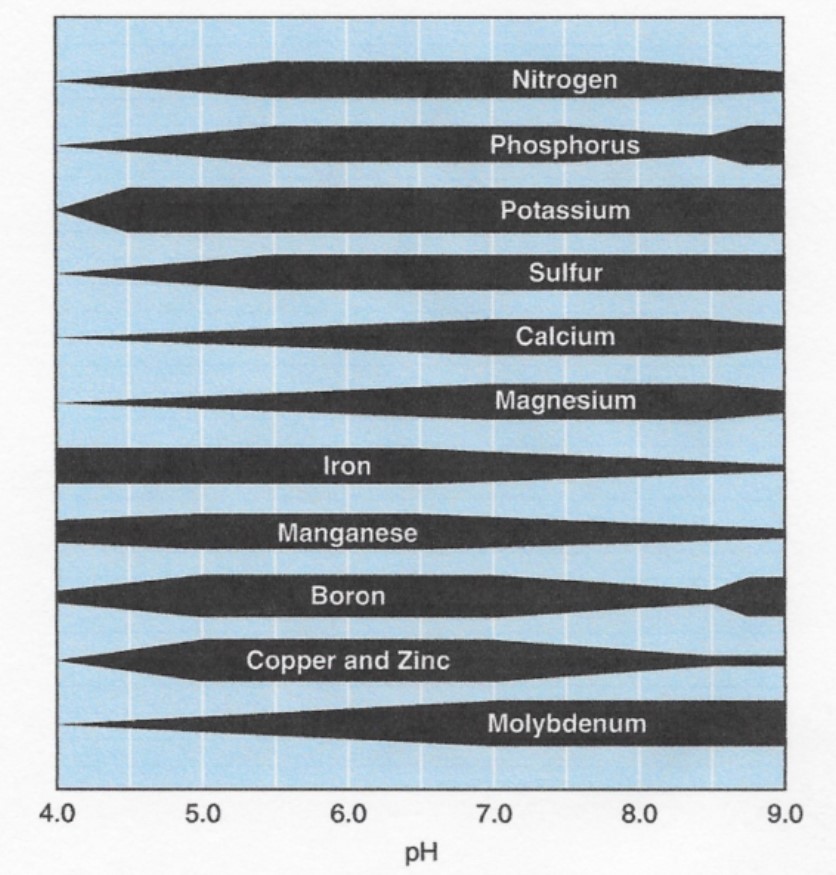
Figure 1. Influence of Soil pH on the Availability of Plant Nutrients. The thickness of bars indicates the availability of nutrients. Image courtesy of UConn Soil Nutrient Analysis Laboratory.
Soil Texture and Cation Exchange Capacity
Soil texture is the percentage of sand, silt and clay particles in a soil sample. Soil texture can influence many agronomic factors within the field including water drainage, retention, root penetration, and nutrient holding capacity within the soil profile. Soils with a high percentage of sand can lead to faster drainage and warming in the spring. However, they have poor water holding capacity and can have increased nutrient loss due to leaching. Soils with a higher percentage of clay retain water and nutrients better than sandy soils but can also suffer from poor drainage and compaction. Loamy soils which are often considered to be some of the best soils for farming, have a balanced mix of clay, sand, and silt. Loamy soils have better drainage than clay soils and can hold nutrients better than sandy soils.

Figure 2. The USDA soil textural triangle. Image courtesy of URCS National Agronomy Manual, February 2011 edition.
Cation exchange capacity or CEC is the measure of a soil’s ability to hold and exchange positively charged ions. Examples of these include calcium, magnesium, ammonium and potassium. CEC is usually reported in milliequivalents per 100 grams of soil (meq/100g) and reflects the soil’s nutrient fertility potential and buffering capacity. Soils with a high
CEC are often high in organic matter or clay particles can retain more nutrients and resist changes in pH. Soils with a low CEC that typically have a large percentage of sand particles require more intensive fertilization programs as they are prone to nutrient leaching and water loss.
Understanding soil texture and CEC helps farmers and agronomists optimize crop product selection, irrigation requirements, and fertilization plans. By using soil test data effectively, it’s possible to enhance productivity, reduce negative environmental impacts, and ensure sustainable agricultural practices can be used. Organic Matter
Organic Matter
In soils organic matter can be generalized as the biological residue of animals and plants at various stages of decomposition. Microorganism residue and their byproducts can also fall into organic matter. It is vital for maintaining or improving soil health, fertility, and plant growth. Soil organic matter directly influences several key soil properties including nutrient retention capabilities, water-holding capacity, and microbial activity. Organic matter can be thought of as a large reservoir within the soil profile that releases nutrients like nitrogen, phosphorus and sulfur as decomposition occurs. It also assists in things like soil aggregation through helping to bind soil particles together, increased water retention, promoting microbial activity, and soil pH buffering.
Soil tests usually report organic matter as a percentage with the typical range being anywhere between 1-6%. It can also be indirectly measured through soil organic carbon. Since carbon is a key component of soil organic matter it can be a valuable metric to report. This measurement is usually given as a percentage or grams/kilogram. Advanced soil tests can sometimes report on decomposed organic matter (humus content) or microbial biomass. Organic matter can be increased or managed by introducing cover crops, applying compost or manure, minimizing tillage and conservative residue management.
Conclusion
Soil testing is a powerful tool that provides valuable insights into the health and fertility of your soil. It helps farmers make informed decisions for optimal crop production and brings value to any operation. Understanding key soil properties such as nutrient composition, pH, organic matter, texture, CEC and biological activity allows for more effective soil management and targeted fertilization. Regular soil testing, along with tailored crop recommendations, can not only help increase productivity but also promote sustainability in agriculture practices. Programs like ForGround with Bayer help empower farmers to make sustainable choices and improve soil health. Soil testing can help you with that mission. Speak to a ForGround representative today by visiting bayerforground.com to learn more about ForGround benefits and how soil testing fits into your operation.
References and Additional Resources:
1 Interpreting test results. University of Illinois Urbana-Champaign. https://extension.illinois.edu/soil/interpreting-test-results
2 Khan, F., Siddique, A.B., Shabala, S., Zhou, M., and Zhao, C. 2023. Phosphorus plays key roles in regulating plants’ physiological responses to abiotic stresses. National Library of Medicine. https://pmc.ncbi.nlm.nih.gov/articles/PMC10421280/#abstract1
3 Kaiser, D. 2024. What is the best soil test option for phosphorus? University of Minnesota Extension. https://blog-crop-news.extension.umn.edu/2021/02/what-is-best-soil-test-option-for.html
4 Pettinelli, D. and Ghimire, S. 2021. Soil pH and management suggestions. University of Connecticut. https://soiltesting.cahnr.uconn.edu/soil-ph-and-management-suggestions/
5 Goldy. R. 2011. What is your soil cation exchange capacity? Michigan State University. https://www.canr.msu.edu/news/what_is_your_soil_cation_exchange_capacity